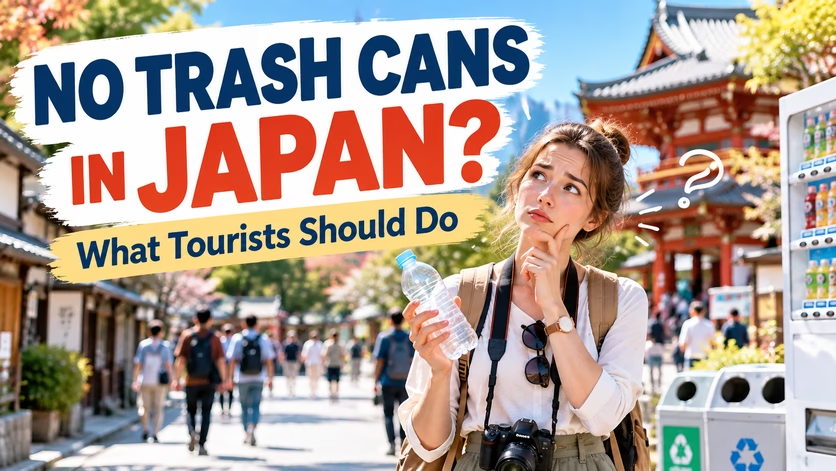
You buy a drink from a vending machine, finish it while exploring Tokyo, and then realize something strange:
There is nowhere to throw the bottle away.
If this happens to you in Japan, don’t worry. You are definitely not the only traveler confused by it.
Japan is famous for its clean streets, but public trash cans can be surprisingly difficult to find. In fact, the shortage of trash cans was the most commonly reported problem among international visitors in the latest Japan Tourism Agency survey published in 2026.
So what should you actually do with your trash?
The simplest answer is:
Carry it with you until you find an appropriate trash or recycling bin.
Here is how garbage disposal actually works when traveling in Japan — and what you should know before heading out for the day.
- 1. Yes, Japan Really Does Have Fewer Public Trash Cans
- 2. Why Are There So Few Trash Cans in Japan?
- 3. What Should I Do With My Trash in Japan?
- 4. Where Can I Find Trash Cans in Japan?
- 5. Can I Throw My Trash Away at a Convenience Store?
- 6. What About Bottles and Cans From Vending Machines?
- 7. Japan Separates Different Types of Waste
- 8. Don’t Leave Trash Beside a Full Bin
- 9. Parks May Not Have Trash Cans Either
- 10. What Should I Do With Food Waste?
- 11. Eating While Walking Can Create Another Problem
- 12. Keep a Small “Trash Kit” in Your Travel Bag
- 13. What If I Can’t Read the Trash Can?
- 14. Don’t Assume Rural Japan Has More Trash Cans
- 15. The Easiest Rule to Remember
- Frequently Asked Questions
- Why are there so few trash cans in Japan?
- Where can tourists throw away trash in Japan?
- Can I use convenience store trash cans?
- Can I throw normal trash into a vending machine recycling box?
- What should I do if there are no trash cans nearby?
- Can I leave trash next to a full garbage can?
- Should I carry a garbage bag while sightseeing in Japan?
- Final Tips: Don’t Let Japan’s Trash Can Problem Stress You Out
1. Yes, Japan Really Does Have Fewer Public Trash Cans
This surprises many first-time visitors.
Walk through central Tokyo, Kyoto or Osaka and you may pass dozens of shops, restaurants and vending machines without seeing a general public trash can on the street.
That doesn’t mean there are no places to dispose of garbage.
It means you shouldn’t assume that a trash can will always be available when you need one.
It is a real problem for international visitors
According to a Japan Tourism Agency survey conducted from November 2025 to January 2026, 17.2% of international visitors said the lack of trash cans caused difficulty during their trip.
It was the most frequently reported problem in the survey.
For comparison, other commonly reported difficulties included communication with staff, congestion at tourist destinations, using public transportation, multilingual signage and credit/debit card use.
So if you’ve ever walked around Japan carrying an empty coffee cup for an hour, you are far from alone.
2. Why Are There So Few Trash Cans in Japan?
There isn’t one simple explanation that applies everywhere.
Waste collection and disposal policies vary by municipality, facility and business.
More importantly for travelers, Japan has developed a strong expectation that people manage the waste they create rather than assuming a public trash can will always be available.
Official tourism guidance reflects this.
JNTO advises visitors to carry their trash when bins are unavailable, while Tokyo’s official tourism guide recommends carrying a small garbage bag and taking waste back to your accommodation when necessary.
For travelers, understanding the history of every missing trash can is less important than knowing what to do next.
ShimaSuki Tip
Don’t plan your day assuming, “I’ll find a trash can later.”
Instead, plan for the possibility that you won’t.
3. What Should I Do With My Trash in Japan?
The safest rule is simple:
Keep it until you find an appropriate place to dispose of it
If you cannot find a bin, put the waste in a small bag and carry it with you.
You may eventually find an appropriate bin at your hotel, station, shopping facility or another location.
Tokyo’s official tourism guidance specifically recommends carrying a small garbage bag because public bins can be limited.
This is one of the easiest Japan travel habits to adopt.
Before leaving your hotel each morning, put one or two small plastic bags or reusable waste pouches in your day bag.
They weigh almost nothing and can save you a surprising amount of frustration.
4. Where Can I Find Trash Cans in Japan?
There is no guaranteed location, but certain places are more likely to have bins than an ordinary street.
Train and subway stations
Some stations have trash and recycling bins, particularly around platforms, ticketed areas or vending-machine zones.
However, availability varies considerably.
Do not assume every station has one.
And if a bin is marked for a particular type of waste, use it only for that category.
Vending machine areas
Drink vending machines sometimes have recycling boxes nearby for empty bottles and cans.
These are generally intended for beverage containers rather than ordinary garbage.
Do not use a bottle recycling box for food packaging, tissues or unrelated waste.
Shopping malls and department stores
Large commercial facilities may provide waste bins, particularly around food courts or dining areas.
Again, follow the labels and use them for the intended waste.
Your hotel
Your accommodation is often the easiest solution for waste accumulated during sightseeing.
If you’re unsure how to separate something, ask hotel staff.
A useful phrase is:
Where can I throw this away?
Japanese:
これはどこに捨てればいいですか?
Kore wa doko ni sutereba ii desu ka?
Showing the item while asking makes communication much easier.
5. Can I Throw My Trash Away at a Convenience Store?
This is where travelers need to be careful.
You may see trash cans at some convenience stores, but not every convenience store has publicly accessible bins.
And a convenience store’s trash facilities should not automatically be treated as a general public garbage disposal point for waste accumulated elsewhere.
If you’re unsure whether you can dispose of something there, ask the staff.
You can say:
Can I throw this away here?
ここに捨ててもいいですか?
Koko ni sutete mo ii desu ka?
If the answer is no, simply take it with you.
Watch Out
Don’t walk into a convenience store with a large bag of garbage collected throughout the day and assume you can leave it there.
Store policies and facilities differ.
6. What About Bottles and Cans From Vending Machines?
This is usually easier.
Around some vending machines, you will see collection boxes designed for beverage containers.
Look for labels or openings indicating:
PET Bottles(ペットボトル)
Cans(缶 / kan)
Bottles(びん / bin)
Use these only for the intended drink containers.
A recycling box next to a vending machine is not necessarily a general trash can.
7. Japan Separates Different Types of Waste
One reason you should pay attention before throwing something away is that bins are often separated by waste type.
You may encounter labels such as:
Burnable Waste(燃えるごみ)
Depending on the location, this may include certain paper and food-related waste.
PET Bottles(ペットボトル)
Plastic beverage bottles.
Cans(缶)
Metal beverage cans.
Bottles(びん)
Glass bottles.
Plastics(プラスチック)
Rules vary depending on the municipality and facility.
The categories are not necessarily identical everywhere in Japan.
So rather than memorizing one national system, read the label on the bin in front of you.
Many tourist areas use pictures or English labels to make separation easier.
8. Don’t Leave Trash Beside a Full Bin
This may seem obvious, but it becomes tempting when you’ve carried your trash around for hours.
If a bin is full, don’t place your garbage on the ground next to it.
Take it with you and find another appropriate disposal point.
JNTO’s responsible travel guidance asks visitors not to leave garbage behind in public spaces.
Japan’s clean streets depend partly on residents and visitors doing exactly this.
9. Parks May Not Have Trash Cans Either
A picnic in a Japanese park can be wonderful.
But don’t assume you’ll be able to throw everything away before leaving.
Tokyo’s official tourism website specifically warns that many parks and gardens do not have garbage cans and advises visitors to be prepared to take their waste with them.
This matters if you’re planning to buy lunch from a convenience store and eat it in a park.
Bring a small garbage bag before your picnic.
10. What Should I Do With Food Waste?
Food waste can be particularly annoying because you don’t want it sitting loose inside your backpack.
A small sealable bag is extremely useful.
Place food packaging or leftovers inside it until you reach an appropriate disposal point.
If possible, finish food near the place where you bought it when a designated eating and disposal area is available.
This can be easier than carrying messy packaging through the city for several hours.
11. Eating While Walking Can Create Another Problem
Japan has no universal rule that simply makes eating while walking illegal.
However, eating while moving can be discouraged in certain locations, and individual shopping streets, attractions or facilities may have their own requests or rules.
There is also a practical issue:
Once you finish eating, you may not find a trash can.
When possible, eat in an appropriate spot and dispose of the packaging there if a suitable bin is provided.
This is especially useful with ice cream, street food, drinks and foods with sauces.
12. Keep a Small “Trash Kit” in Your Travel Bag
This is one of our simplest ShimaSuki recommendations for traveling in Japan.
Your kit doesn’t need to be complicated.
Carry:
- Two or three small bags
- A sealable bag for wet or food waste
- Tissues
- Hand sanitizer
That’s it.
A tiny waste kit takes up almost no room and solves one of the most commonly reported frustrations among visitors to Japan.
13. What If I Can’t Read the Trash Can?
Look for pictures first.
Many bins use symbols showing bottles, cans or other types of waste.
Useful Japanese words include:
Trash / Garbage — ごみ (gomi)
Burnable — 燃える (moeru)
PET Bottle — ペットボトル (petto botoru)
Can — 缶 (kan)
Bottle — びん (bin)
Plastic — プラスチック (purasuchikku)
If you still aren’t sure, don’t guess.
Ask a staff member or keep the item with you until you find a bin you understand.
14. Don’t Assume Rural Japan Has More Trash Cans
This issue isn’t limited to Tokyo.
In some rural destinations, islands, historic towns and nature areas, public bins may be even harder to find.
For example, JNTO highlights Iwami Ginzan in Shimane as a historic tourist destination where there are no public trash cans and visitors take their garbage with them.
If you’re traveling outside Japan’s major cities, being prepared to carry your waste becomes even more important.
ShimaSuki Tip
The more remote your destination, the more useful your small trash bag becomes.
This is particularly important when hiking, visiting beaches, exploring islands or spending time in natural areas.
15. The Easiest Rule to Remember
If all of this feels complicated, remember just three things:
Find the correct bin.
Separate your waste according to the labels.
If there is no bin, carry your trash with you.
That’s enough to handle most situations you’ll encounter as a visitor.
Frequently Asked Questions
Why are there so few trash cans in Japan?
There is no single explanation that applies to every location. Public waste facilities vary between municipalities and facilities, while travelers are commonly expected to keep their waste until an appropriate disposal point is available.
Where can tourists throw away trash in Japan?
Depending on the location, you may find suitable bins at some stations, commercial facilities, vending-machine areas and other facilities. Your hotel is also a useful place to ask about proper waste disposal.
Can I use convenience store trash cans?
Some convenience stores have accessible trash bins and others do not. Policies vary. Don’t assume a store will accept garbage generated elsewhere; ask staff if you’re unsure.
Can I throw normal trash into a vending machine recycling box?
No. Use collection boxes only for the items indicated, such as PET bottles or cans.
What should I do if there are no trash cans nearby?
Carry your waste until you find an appropriate disposal point. JNTO and Tokyo’s official tourism guidance recommend bringing a small trash bag for this purpose.
Can I leave trash next to a full garbage can?
No. If the bin is full, keep your waste and find another appropriate place to dispose of it.
Should I carry a garbage bag while sightseeing in Japan?
Yes. It is one of the simplest ways to make traveling around Japan easier. A small sealable bag is especially useful for food packaging.
Final Tips: Don’t Let Japan’s Trash Can Problem Stress You Out
Japan’s lack of public trash cans can feel strange at first.
But once you know what to expect, it becomes much easier to manage.
Before leaving your accommodation each morning, put a small garbage bag in your backpack or handbag.
Use designated bins when you find them, follow the separation labels, and keep your waste with you when you don’t.
It’s a tiny travel habit — but one that can make exploring Japan considerably easier.
Read Next on ShimaSuki
Japan Travel in October 2026: 15 Things You Need to Know Before Your Trip
Japan Convenience Store Guide: What First-Time Visitors Need to Know
Can You Travel Japan Without Speaking Japanese? A Practical Guide
Cash, Credit Cards or IC Cards? How to Pay in Japan in 2026