You’re planning your first trip to Japan.
Your hotels are booked. Your itinerary is ready. You’re excited about Tokyo, Kyoto, sushi, temples and maybe even a trip into rural Japan.
Then one concern appears:
“I don’t speak Japanese. Will I be okay?”
The short answer is:
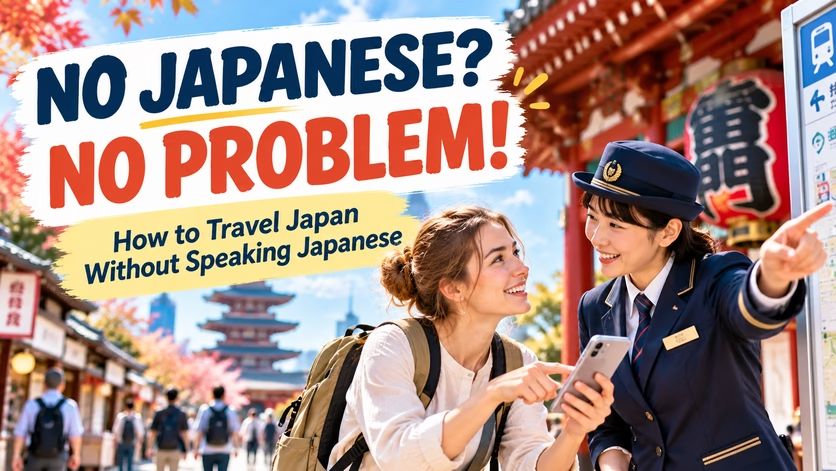
Yes. You can absolutely travel around Japan without speaking Japanese.
In major tourist destinations, airports, hotels and transportation systems, English support is widely available.
However, that doesn’t mean you’ll never experience a language barrier.
According to a Japan Tourism Agency survey published in 2026, communication with staff was one of the most common difficulties reported by international visitors.
The good news?
You don’t need to spend months learning Japanese before your trip.
With a smartphone, a few useful phrases and some preparation, most travelers can handle everyday situations surprisingly well.
Here’s what you should know.
- How Much English Is Spoken in Japan?
- Where Does the Language Barrier Become More Noticeable?
- Your Smartphone Is Your Best Translation Tool
- Save Important Information in Japanese
- Learn These Japanese Phrases Before Your Trip
- How to Order Food Without Speaking Japanese
- Using Trains Without Speaking Japanese
- What About Buses?
- Traveling in Rural Japan Without Japanese
- Tourist Information Centers Can Help
- What If Someone Speaks to Me in Japanese?
- What If My Phone Has No Internet?
- What About Emergencies?
- 10 Japanese Words Worth Remembering
- What Should I Prepare Before Traveling to Japan?
- Frequently Asked Questions
- Can I visit Japan if I only speak English?
- Are train stations in Japan written in English?
- Do restaurant staff in Japan speak English?
- What translation app should I use in Japan?
- Do I need to learn Japanese before visiting Japan?
- Can I travel to rural Japan without speaking Japanese?
- What should I do if I get completely lost?
- What number should tourists call in an emergency in Japan?
- Final Thoughts: Don’t Let the Language Barrier Stop You
How Much English Is Spoken in Japan?
Japan’s main language is Japanese.
In major tourist destinations, however, travelers will frequently encounter English.
Places where English is commonly available
You’ll generally find English information at:
- Major international airports
- Shinkansen stations
- Major train and subway stations
- Large hotels
- Major tourist attractions
- Tourist information centers
- Many ticket machines
- Large shopping centers
Train stations in major cities frequently display station names and directions in both Japanese and English.
Many transportation announcements are also provided in English.
That means navigating Tokyo, Osaka, Kyoto and other major tourist destinations is usually much easier than first-time visitors expect.
Where Does the Language Barrier Become More Noticeable?
Things can become more challenging once you move beyond major tourist infrastructure.
You may encounter limited English at:
- Small local restaurants
- Independent shops
- Rural bus stops
- Small railway stations
- Local accommodation
- Countryside attractions
- Medical facilities
- Smaller towns and islands
This doesn’t mean you shouldn’t visit these places.
It simply means you should prepare slightly differently.
What travelers actually struggle with
A 2026 Japan Tourism Agency survey found that 15.4% of surveyed international visitors reported difficulty communicating with facility staff.
Among travelers who experienced communication problems, restaurants were the most commonly reported location, followed by railway stations and bus terminals.
So the language barrier is real.
But here’s another important part of the survey:
Many travelers solved the problem using technology.
Your Smartphone Is Your Best Translation Tool
You don’t need perfect Japanese.
Sometimes you don’t even need to speak.
Translation apps can help with:
- Restaurant menus
- Train information
- Hotel instructions
- Signs
- Conversations
- Shopping
- Asking directions
Camera translation is particularly useful.
If you see a Japanese-only menu or sign, open your translation app and point your camera at the text.
It may not produce a perfect translation every time, but it can often give you enough information to understand what you’re looking at.
ShimaSuki Tip
Before arriving in Japan, download your preferred translation app and any available offline Japanese language data.
Don’t wait until you’re standing inside a tiny restaurant with poor reception to set everything up.
Save Important Information in Japanese
This is one of the most useful tricks for first-time visitors.
Before leaving your hotel, save your destination’s name and address in Japanese.
For example, instead of only saving:
Shinjuku Station
also save:
新宿駅
If you become confused, you can simply show the Japanese text to station staff, a taxi driver or someone nearby.
This is especially useful when visiting smaller destinations.
Learn These Japanese Phrases Before Your Trip
You don’t need to become fluent.
Even five or ten expressions can make traveling easier.
Sumimasen(すみません)
Excuse me / Sorry
Possibly the most useful word you’ll learn.
Use it when getting someone’s attention, asking a question or politely apologizing.
Arigatou gozaimasu(ありがとうございます)
Thank you
You’ll probably use this several times every day.
Wakarimasen(わかりません)
I don’t understand.
Useful when someone explains something in Japanese and you’re completely lost.
Eigo wa hanasemasu ka?(英語は話せますか?)
Do you speak English?
Don’t worry if the answer is no.
That’s when your translation app becomes useful.
___ wa doko desu ka?(___はどこですか?)
Where is ___?
For example:
Toire wa doko desu ka?
Where is the toilet?
Ikura desu ka?(いくらですか?)
How much is it?
Useful in shops, markets and smaller businesses.
Kore onegaishimasu(これお願いします)
This one, please.
Extremely useful in restaurants.
Point at a menu item or picture and say:
Kore onegaishimasu.
You have just ordered without needing a complicated conversation.
How to Order Food Without Speaking Japanese
Restaurants are one of the situations where travelers most frequently experience communication difficulties.
Fortunately, they’re also one of the easiest situations to prepare for.
Look for picture menus
Many restaurants in tourist areas have:
- English menus
- Picture menus
- Tablet ordering
- QR-code menus
- Food models displayed outside
These can make ordering very straightforward.
Pointing is completely fine
If you can’t pronounce the name of a dish, point at it.
Say:
Kore onegaishimasu.
“This one, please.”
Simple communication often works better than trying to construct a complicated sentence.
Dietary restrictions require more preparation
This is where you should not rely only on spontaneous conversation.
If you have a serious food allergy or important dietary restriction, prepare a clearly written explanation in Japanese before your trip.
For example, save a card on your phone explaining exactly which ingredients you cannot eat.
Don’t rely solely on automatic translation for potentially serious medical or allergy information.
Using Trains Without Speaking Japanese
Japan’s railway network looks intimidating.
But language is usually not the hardest part.
The bigger challenge is often understanding which train, platform or exit you need.
Major stations commonly provide English signage, and many announcements are multilingual.
Your smartphone navigation app can also help you identify:
- Departure time
- Platform
- Transfers
- Train line
- Destination
- Arrival time
Station numbers are your friend
Many subway and railway systems use station codes.
For example, instead of trying to remember a long Japanese station name, you may see something like:
G09
These codes can make navigation considerably easier.
Show staff your destination
If you’re confused, don’t struggle silently.
Show station staff the destination on your phone.
You can say:
Koko ni ikitai desu.
ここに行きたいです。
“I want to go here.”
This is often enough for someone to point you toward the correct platform.
What About Buses?
Buses can be more difficult than trains, particularly outside major cities.
You may encounter:
- Limited English signage
- Different boarding procedures
- Cash-only payment
- Numbered tickets
- Front-door or rear-door boarding
- Limited English announcements
Procedures vary between regions and operators.
Before taking a rural bus, check the route and payment method in advance whenever possible.
Take a screenshot of your destination in Japanese.
If you’re unsure whether you’re on the correct bus, show the driver your destination before sitting down.
Traveling in Rural Japan Without Japanese
This is where travelers sometimes become nervous.
But don’t let the language barrier stop you from exploring beyond Tokyo and Kyoto.
Some of Japan’s most memorable experiences are found in smaller towns, islands and rural areas.
You simply need a little more preparation.
Before heading somewhere remote:
- Download offline maps
- Save your accommodation address in Japanese
- Screenshot transportation schedules
- Carry some cash
- Download offline translation tools
- Check the last bus or train of the day
- Save important phone numbers
Good to Know
The smaller the destination, the less you should depend on finding English-speaking staff everywhere.
Prepare important information before leaving a major city.
Tourist Information Centers Can Help
If you’re completely stuck, look for a tourist information center.
JNTO operates a certification program for tourist information centers serving international visitors throughout Japan.
The level of language support varies by category, but certified centers can provide varying levels of foreign-language assistance.
They can be particularly helpful with:
- Transportation
- Local attractions
- Accommodation
- Maps
- Regional travel advice
Look for tourist information services around major stations and tourist destinations.
What If Someone Speaks to Me in Japanese?
Don’t panic.
You don’t have to pretend you understand.
Say:
Sumimasen. Wakarimasen.
“Sorry, I don’t understand.”
Then use your phone.
You can also type:
英語でも大丈夫ですか?
“Is English okay?”
Even when two people don’t share a language, pointing, maps, numbers and translation apps can solve a surprising number of problems.
What If My Phone Has No Internet?
This is why offline preparation matters.
Before your trip:
- Download offline maps
- Download offline Japanese translation data if your app supports it
- Screenshot hotel addresses
- Screenshot train reservations
- Save QR codes locally
- Save emergency information
Your phone is extremely useful in Japan — but don’t design your entire trip around having perfect internet access every second.
What About Emergencies?
This is one situation where you should prepare before anything happens.
In Japan:
Police: 110
Fire / Ambulance: 119
JNTO also operates the Japan Visitor Hotline for international travelers.
It is available 24 hours a day, 365 days a year, with support in English, Chinese and Korean.
Japan Visitor Hotline:
050-3816-2787
From overseas:
+81-50-3816-2787
The hotline can provide assistance during accidents, illness, natural disasters and other travel-related situations.
Save this number before your trip.
10 Japanese Words Worth Remembering
If you only learn a few words, start here:
Sumimasen — Excuse me / Sorry
Arigatou — Thank you
Hai — Yes
Iie — No
Wakarimasen — I don’t understand
Daijoubu — Okay / All right
Doko? — Where?
Ikura? — How much?
Toire — Toilet
Eki — Station
You don’t need perfect pronunciation.
Making an effort is usually far more useful than remaining silent because you’re worried about making a mistake.
What Should I Prepare Before Traveling to Japan?
Here’s your language checklist.
Before departure
Download a translation app.
Download offline maps.
Save your hotels in both English and Japanese.
Save important destinations in Japanese.
Screenshot important reservations.
Save the Japan Visitor Hotline.
Learn “Sumimasen” and “Arigatou gozaimasu.”
That’s enough to get started.
Frequently Asked Questions
Can I visit Japan if I only speak English?
Yes. Major airports, tourist destinations, hotels and transportation systems generally provide significant English support. However, English may be less widely understood in rural areas and small local businesses.
Are train stations in Japan written in English?
Major stations generally provide English station names, directions and other information. Many transportation systems also use station numbers and Roman letters.
Do restaurant staff in Japan speak English?
It varies considerably. Restaurants in major tourist destinations may provide English menus or ordering systems, while small local restaurants may have limited English support.
What translation app should I use in Japan?
Choose a reputable translation app that supports Japanese text, camera translation and ideally offline functionality. Set it up before your trip rather than waiting until you encounter a language problem.
Do I need to learn Japanese before visiting Japan?
No. You can travel around Japan without speaking Japanese. However, learning a few basic phrases will make everyday interactions easier and can make your trip more enjoyable.
Can I travel to rural Japan without speaking Japanese?
Yes, but preparation becomes more important. Save destinations in Japanese, download offline maps, check transportation schedules beforehand and keep screenshots of important information.
What should I do if I get completely lost?
Find station staff or a tourist information center and show them your destination on your phone. Having the destination written in Japanese can make communication much easier.
What number should tourists call in an emergency in Japan?
Call 110 for police and 119 for fire or ambulance. International travelers can also contact the JNTO Japan Visitor Hotline for multilingual travel and emergency assistance.
Final Thoughts: Don’t Let the Language Barrier Stop You
You do not need to speak Japanese to have an amazing trip to Japan.
There will probably be moments when communication isn’t perfect.
You might point at a menu.
You might show someone your phone.
You might misunderstand something and try again.
That’s completely normal.
The key isn’t speaking perfect Japanese.
It’s being prepared.
Download the right tools, save important information in Japanese, learn a handful of useful phrases and don’t be afraid to ask for help.
Then go explore.
Japan is much more accessible to non-Japanese speakers than it may look from thousands of miles away.
Read Next on ShimaSuki
Where Are the Trash Cans in Japan? A Practical Guide for Tourists
Japan Travel in October 2026: 15 Things You Need to Know Before Your Trip
Japan Public Transportation Guide: How to Use Trains, Buses and IC Cards
Japan Convenience Store Guide: What First-Time Visitors Need to Know
Cash, Credit Cards or IC Cards? How to Pay in Japan in 2026