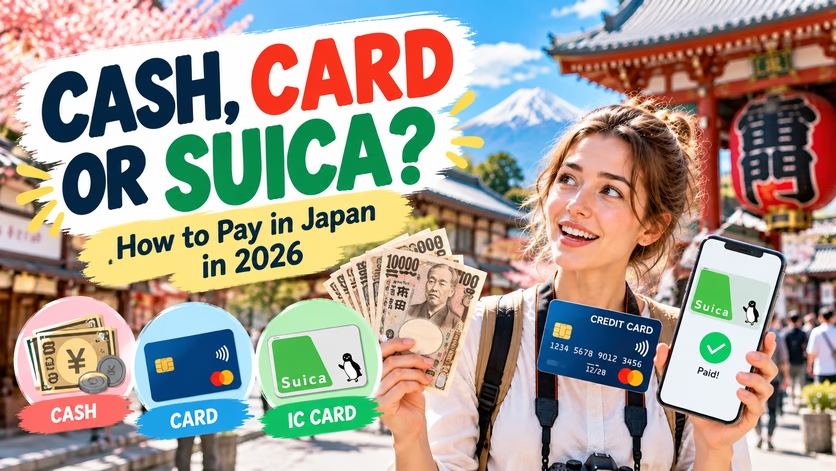
Japan has a reputation for being a cash-based country.
But is that still true in 2026?
If you’re planning your first trip to Japan, you may be wondering:
Should I bring cash?
Can I just use my credit card?
What exactly is Suica?
Can I pay for shopping with an IC card?
The reality is that Japan has become much more cashless — but traveling completely without cash can still cause problems.
The easiest strategy is not choosing between cash, cards and IC cards.
Use all three.
Here’s how payments actually work in Japan in 2026.
- The Simple Answer: Carry Three Ways to Pay
- Are Credit Cards Widely Accepted in Japan in 2026?
- Where Might You Still Need Cash?
- How Much Cash Should I Carry in Japan?
- Don’t Be Afraid of the ¥10,000 Note
- What Is an IC Card?
- IC Cards Aren’t Just for Trains
- Welcome Suica Mobile: A Useful Option for iPhone Users
- TOURIST PASMO Is New for 2026
- Can I Use Suica in Osaka or Kyoto?
- Can I Use an IC Card for the Shinkansen?
- Can I Pay With Apple Pay or Google Pay in Japan?
- What If My Credit Card Doesn’t Work?
- Where Can I Withdraw Cash in Japan?
- Should I Exchange Money Before Arriving in Japan?
- Should I Choose JPY or My Home Currency?
- Do I Need to Tip in Japan?
- A Realistic Payment Strategy for One Day in Japan
- What About Rural Japan?
- Payment Checklist Before Your Japan Trip
- Frequently Asked Questions
- Is Japan still a cash-based country in 2026?
- Can I travel Japan using only a credit card?
- How much cash should I carry in Japan?
- Is Suica only for Tokyo trains?
- Can I use Suica at convenience stores?
- What happened to PASMO PASSPORT?
- Can foreign tourists get TOURIST PASMO?
- Where can foreigners withdraw Japanese yen?
- Final Answer: Cash, Card or IC Card?
The Simple Answer: Carry Three Ways to Pay
For most international travelers, we recommend having:
1. A credit or debit card
For hotels, shopping, restaurants and larger purchases.
2. An IC card such as Suica or PASMO
For trains, buses and many small everyday purchases.
3. Some Japanese yen in cash
For smaller businesses, rural destinations and situations where electronic payment isn’t available.
Think of them as three layers.
Your card handles larger payments.
Your IC card handles everyday convenience.
Cash is your backup — and sometimes your only option.
Are Credit Cards Widely Accepted in Japan in 2026?
Yes.
Credit card acceptance has expanded significantly throughout Japan.
According to JNTO, international credit and debit cards are generally accepted across the country.
You’ll commonly be able to use cards at:
- Major hotels
- Department stores
- Shopping malls
- Convenience stores
- Chain restaurants
- Major tourist attractions
- Large supermarkets
- Many taxis
- Shinkansen ticket counters and machines
Visa and Mastercard are among the most widely accepted international brands.
Contactless card payments have also become increasingly common.
However, there’s one important rule:
Never assume everywhere accepts cards.
Where Might You Still Need Cash?
Cash remains useful — and sometimes essential — in Japan.
You may encounter cash-only payment at:
- Small independent restaurants
- Traditional shops
- Rural businesses
- Small guesthouses
- Temples and shrines
- Local markets
- Rural buses
- Small museums or attractions
- Coin-operated facilities
This becomes particularly important when traveling outside major cities.
JNTO specifically advises travelers visiting rural, remote or off-the-beaten-track destinations to check payment methods beforehand and carry cash.
ShimaSuki Tip
If you’re spending the entire day in central Tokyo, you’ll probably use very little cash.
If you’re visiting a small island, mountain village or rural town, don’t assume the same payment environment exists.
Withdraw cash before heading somewhere remote.
How Much Cash Should I Carry in Japan?
There isn’t one perfect amount because it depends on your itinerary.
For a typical sightseeing day in a major city, having around:
¥5,000–¥10,000 in cash
as backup is a reasonable starting point for many travelers.
This is not an official requirement — simply a practical range that can cover smaller meals, local transportation and unexpected cash-only situations.
If you’re heading into rural Japan, consider carrying more depending on your plans.
The important thing isn’t carrying a huge amount.
It’s avoiding a situation where you have zero yen and suddenly discover that the restaurant, bus or attraction in front of you is cash-only.
Don’t Be Afraid of the ¥10,000 Note
First-time visitors sometimes hesitate to use a ¥10,000 note for a relatively small purchase.
Generally, this isn’t a problem.
JNTO notes that ¥10,000 notes are normally accepted even for small purchases.
Japanese currency currently includes banknotes and coins, and you’ll probably accumulate more coins than expected during your trip.
A small coin purse can actually be surprisingly useful.
What Is an IC Card?
An IC card is one of the most useful things you can have while traveling in Japan.
Cards such as:
Suica
PASMO
ICOCA
TOICA
and other regional cards function as rechargeable stored-value cards.
Instead of buying a ticket every time you use a train, you simply:
Tap in → ride → tap out.
The fare is automatically deducted from your balance.
Most major IC cards are interoperable across many transportation networks in Japan, although there are exceptions.
IC Cards Aren’t Just for Trains
This is where many first-time visitors are surprised.
Your IC card can also be used at many:
- Convenience stores
- Vending machines
- Station lockers
- Shops
- Restaurants
- Taxis
Look for the IC symbol near the payment terminal.
This makes an IC card particularly useful for small purchases.
Buying a ¥160 drink?
Instead of searching through your coins:
Tap. Done.
Welcome Suica Mobile: A Useful Option for iPhone Users
International travelers using compatible iPhones now have another convenient option.
JR East offers Welcome Suica Mobile, an iOS app designed for overseas visitors.
You can issue a Suica digitally and add value using a credit card registered with Apple Pay.
It can then be used for trains, buses and shopping at locations displaying the IC logo.
That means you may be able to start using Suica without purchasing a physical card after arriving in Japan.
Good to Know
Mobile IC compatibility depends on your device and setup.
Don’t assume every overseas smartphone will support every Japanese mobile payment function.
Check compatibility before your trip.
TOURIST PASMO Is New for 2026
This is an important update if you’re reading older Japan travel guides.
PASMO PASSPORT is no longer the current tourist card.
Sales of PASMO PASSPORT ended in 2024.
In May 2026, a new product called TOURIST PASMO launched for international visitors staying in Japan on short-term trips.
TOURIST PASMO can be used on participating trains and buses and for cashless purchases at compatible stores.
Key TOURIST PASMO facts
The card:
- Is designed for international visitors
- Requires no deposit
- Is valid for 28 days from purchase
- Can be used on IC-compatible transportation
- Can be used for shopping at participating businesses
- Can be purchased at selected locations around Haneda and Narita airports
- Cannot have its remaining stored value refunded
Purchase prices currently range from ¥1,000 to ¥10,000, depending on the sales location.
Watch Out
If you find an older article telling you to buy a PASMO PASSPORT, that information is outdated.
Look for TOURIST PASMO instead.
Can I Use Suica in Osaka or Kyoto?
Generally, yes.
One of the great advantages of Japan’s major IC cards is interoperability.
A Suica purchased in Tokyo can be used across many IC-compatible transportation networks elsewhere in Japan, including major urban areas.
Similarly, an ICOCA obtained in western Japan can be used on many compatible services in Tokyo.
But this does not mean every train, bus or transportation service in Japan accepts every IC card.
Some rural railways, buses and other transportation services may not accept IC cards.
Always look for the IC symbol.
Can I Use an IC Card for the Shinkansen?
Don’t assume that tapping a normal IC card balance works the same way as riding an ordinary commuter train.
Shinkansen travel has separate ticketing systems and requirements.
Depending on the service, you may be able to link an IC card to a reserved ticket or use specific mobile services.
Welcome Suica Mobile also supports certain JR East Shinkansen use cases.
But for first-time visitors, the safest rule is:
Treat Shinkansen tickets separately from normal IC-card train travel unless you have specifically set up the appropriate service.
Can I Pay With Apple Pay or Google Pay in Japan?
Sometimes.
But don’t assume that every mobile payment method you use at home will work everywhere in Japan.
JNTO notes that overseas smartphone payment systems may not always be usable, depending on the payment method and device.
Japan also has domestic QR-payment services that tourists may see frequently.
For international travelers, a physical international credit card plus an IC card and cash remains a much more reliable combination.
What If My Credit Card Doesn’t Work?
Don’t panic.
Payment errors can happen even when a business normally accepts international cards.
Try:
- Another credit card
- A physical card instead of contactless payment
- Your IC card, if accepted
- Cash
This is another reason not to travel with only one payment method.
ShimaSuki Tip
Bring at least two cards from different accounts or networks if possible.
Keep them separately.
If one card is lost, blocked or unexpectedly rejected, you still have another option.
Where Can I Withdraw Cash in Japan?
Two of the most useful options for international visitors are:
Seven Bank ATMs
These are commonly found inside 7-Eleven convenience stores.
Seven Bank ATMs support many overseas-issued cards and provide multilingual interfaces.
Japan Post Bank ATMs
Japan Post Bank ATMs are another important option for travelers using international cards.
They can be found at many post offices and some other locations.
JNTO specifically identifies Seven Bank and Japan Post Bank ATMs as options for withdrawing cash with overseas-issued cards.
Watch Out
ATM fees, your own bank’s international withdrawal fees and exchange rates can vary.
Check your card issuer’s conditions before traveling.
Should I Exchange Money Before Arriving in Japan?
You don’t necessarily need to arrive carrying all the yen you’ll use during your trip.
Currency exchange services are available at major Japanese airports, and international visitors can withdraw yen from compatible ATMs after arrival.
However, arriving with at least some yen can make your first few hours easier.
You may want cash for:
- Small transportation expenses
- Food
- Lockers
- Smaller shops
- Unexpected situations
JNTO recommends keeping some Japanese yen available during your trip.
Should I Choose JPY or My Home Currency?
When a card terminal or ATM offers you the option to pay in Japanese yen or your home currency, pay attention before pressing a button.
Some systems may offer currency conversion at the terminal.
The exchange rate and fees can differ from those offered by your card issuer.
Check your card’s foreign transaction and currency-conversion terms before your trip so you understand which option makes sense for you.
Don’t automatically accept a conversion option simply because your home currency looks more familiar.
Do I Need to Tip in Japan?
Generally, no.
Japan does not have the same tipping culture found in countries such as the United States.
JNTO states that tipping is not customary at restaurants, hotels, taxis and other standard services.
You normally pay the amount shown on the bill.
So don’t add 15% or 20% simply because that’s what you do at home.
A Realistic Payment Strategy for One Day in Japan
Here’s what a normal sightseeing day might look like.
Morning
Take the subway:
IC card
Buy coffee at a convenience store:
IC card or credit card
Lunch
Eat at a restaurant:
Credit card
If it’s a small cash-only restaurant:
Cash
Afternoon
Buy souvenirs at a department store:
Credit card
Buy a drink from a vending machine:
IC card or coins
Evening
Take the train:
IC card
Eat at an izakaya:
Card or cash depending on the restaurant
This is why there isn’t one perfect payment method.
Each one has a role.
What About Rural Japan?
This deserves special attention.
Cashless payments have become increasingly common across Japan, but acceptance is not identical everywhere.
Small islands, mountain villages and rural communities may have:
- Fewer ATMs
- Cash-only restaurants
- Cash-only accommodation
- Buses that don’t accept IC cards
- Smaller businesses without international card terminals
If you’re heading somewhere remote, withdraw enough yen beforehand.
For ShimaSuki readers exploring Japan beyond the standard Tokyo–Kyoto route, this is particularly important.
Payment Checklist Before Your Japan Trip
Before leaving home:
Credit cards
Tell your bank you’re traveling if required.
Check foreign transaction fees.
Check your PIN.
Bring a backup card.
IC card
Decide whether you’ll use:
- Physical Suica/PASMO/another regional IC card
- Welcome Suica Mobile
- TOURIST PASMO
Cash
Arrive with some yen or know where you’ll withdraw it.
Smartphone
Set up compatible mobile payment options before departure.
Don’t rely on your phone as your only payment method.
Frequently Asked Questions
Is Japan still a cash-based country in 2026?
Cashless payment is now widespread, particularly in cities and major tourist destinations. However, cash remains important at some small businesses and in rural areas. JNTO recommends carrying cash as a backup.
Can I travel Japan using only a credit card?
It may be possible for much of a city-based trip, but it isn’t recommended. You can still encounter cash-only businesses or transportation.
How much cash should I carry in Japan?
There is no official amount. For many city travelers, keeping approximately ¥5,000–¥10,000 as daily backup can be practical, while rural travel may require more depending on your plans.
Is Suica only for Tokyo trains?
No. Major IC cards are interoperable across many compatible transportation networks around Japan, although some services and regions are exceptions.
Can I use Suica at convenience stores?
Yes, Suica and other compatible IC cards can be used at many convenience stores and other businesses displaying the appropriate IC payment logo.
What happened to PASMO PASSPORT?
Sales ended in 2024. A new international visitor product called TOURIST PASMO launched in May 2026.
Can foreign tourists get TOURIST PASMO?
Yes. It is designed for eligible overseas visitors on short-term stays and is available at selected airport-area railway locations. It is valid for 28 days.
Where can foreigners withdraw Japanese yen?
Seven Bank and Japan Post Bank ATMs are among the main options identified by JNTO for travelers using overseas-issued cards.
Final Answer: Cash, Card or IC Card?
Don’t choose just one.
For the easiest trip to Japan in 2026:
Use your credit card for larger purchases.
Use an IC card for transportation and everyday small payments.
Keep Japanese yen as your backup.
That combination gives you the flexibility to move from a modern Tokyo department store to a tiny countryside restaurant without worrying about how you’re going to pay.
And if you’re planning to explore Japan beyond the major cities?
Keep a little extra cash in your wallet.
You may be very glad you did.
Read Next on ShimaSuki
Can You Travel Japan Without Speaking Japanese? A Practical Guide for First-Time Visitors
Where Are the Trash Cans in Japan? A Practical Guide for Tourists
Japan Travel in October 2026: 15 Things You Need to Know Before Your Trip
Japan Public Transportation Guide: How to Use Trains, Buses and IC Cards
Japan Convenience Store Guide: What First-Time Visitors Need to Know